| DEVOTIONAL RITUAL |  |
Many of these essays first appeared in the
Scarlet Letter.
All essays written by Fr.
Pnesomauma
unless otherwise noted.
| DEVOTIONAL RITUAL | |
[Constructing Devotions |
Dog Devotions | Canonical Devotions]
(Solo Ritual Design Technique)
Simple devotions will generally not require special dress
or equipment, since it is desirable to be able to perform them frequently
in varying circumstances. The primary purpose of devotional ritual is to
fill the ritualist's awareness with the presence of the object of his devotion,
i.e. the augoeides, god, goddess, angel, or what have you. The three principal
components of that awareness for most people are the verbal/auditory, the
corporeal/kinesthetic, and the visual.
This method of ritual construction starts with the verbal/auditory, by
beginning with the selection of a text to be spoken. The text may be original,
traditional, or a mixture of the two. The important criteria are that it
should
Criterion 1. is simple enough. With regard to 2., the length
of the text, it is best to keep it short. 56 to 156 words is generally
optimal, although much longer or much shorter texts may be used. A reasonably
short devotion may be repeated for a longer practice, or it may be included
as a module in a larger ceremony. Criterion 3. is basically subjective,
but it is usually best if the text has a poetic quality, both because of
the mnemonic advantages of poetry, and because poetic structuring of language
lends itself to the orderly addition of other ritual elements.
As an example, let us illustrate the construction of a devotional ritual
from the first verse of Liber
Cordis Cincti Serpente:
I am the heart, and the snake is entwined
About the invisible core of the mind.
Arise, o my snake! It is now the hour
Of the hooded and holy ineffable flower.
Rise, o my snake, into brilliance of bloom
On the corpse of Osiris afloat in the tomb.
O heart of my mother, my sister mine own,
Thou art given to Nile, to the terror Typhon
Ah, me! But the fury of ravening storm
Enswathes Thee and wraps Thee in frenzy of form.
Be still, o my soul, that the spell may dissolve,
As the wands are upraised and the aeons revolve.
Behold! In my beauty how joyous Thou art,
O snake that carresses the crown of mine heart!
Behold, we are one, and the tempest of years
Goes down to the dusk, and the beetle appears.
O beetle! The drone of thy dolorous note
Be ever the trance of this tremulous throat.
I await the awaking, the summons on high,
From the Lord Adonai, from the Lord Adonai.
Once the text has been selected, it must be broken into
segments based on the sense of the text. In the present case, there are
10 distinct couplets, which may also be grouped as 5 quatrains. Then the
corporal/kinaesthetic elements can be added, by assigning signs or gestures
to each of the sequential segments of the text. The grade signs of the
A.'.A.'. (see diagram in Magick) form a fairly comprehensive arsenal of
such signs, divided into sets as follows:
Typically, use of one of the signs in a set will necessitate
the use of some or all of the others in that group, either as a measure
of balance (e.g. the Elemental Signs) or to complete a formula (e.g. the
LVX Signs). One or more of these groups can furnish all of the signs needed
to work out the somatic/ kinaesthetic ingredients of the ritual.
Other sources of signs include the Degree Signs of O.T.O. as well as their
historical Masonic equivalents from the Rite of Memphis and Mizraim. The
devotee may also invent signs to illustrate concepts not addressed by these
systems.
The simplest way to work out our example would probably be to assign the
LVX Signs to the
five quatrains. Those signs are particularly relevant to the subject matter
of the text, and they fall elegantly into their usual order.
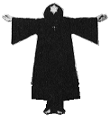 |
In the first quatrain, the devotee makes the Sign of Osiris Slain, to signify the fervor of his aspiration. |
|
|
In the second quatrain, the Sign of Isis Weeping is congruent with the "heart of my mother, my sister, mine own." |
|
|
In the third, the sign of Typhon and Apophis embodies "the fury of ravening storm." |
|
|
The Sign of Osiris Risen suits the sense of accomplishment that provokes the repeated "Behold!" in the fourth quatrain. |
|
The fifth returns to the Sign of Osiris Slain as the devotee awaits the renewal of the process. |
Finally, the addition of a visual, or more usually visualized,
component synchronous with the others completes the design of the devotion.
Visualizations can take many forms, from simple energy shapes to glyphs,
sigils, and words, to imagined scenery and "telesmatic images"
of entities. Again, the key is to keep these visualizations consistent
with the sense of the text and the intent of the devotion. Ritualists'
visualization abilities will differ, but the optimum is to visualize images
of the greatest complexity that the devotee can sustain, thus consuming
that component of the attention in a productive visualization. Growing
a little more baroque, then, here is a set of visualizations that could
be used with the ten couplets of our example:
|
LINES |
SIGN |
VISUALIZATION |
| 1-2 | Osiris Slain | The serpent kundalini coiled 3 1/2 times around the muladhara chakra at the base of the devotee's spine. |
| 3-4 | The ascent of energy to the swadhistthana chakra, and the opening of the lotus at that point. | |
| 5-6 | Isis Weeps | Energy rises further to open the lotus at the manipura chakra at the solar plexus. |
| 7-8 | The motion continues to the anahata chakra, with the lotus opening at the heart. | |
| 9-10 | Typhon | On the heart or in the anahata lotus the formation of the Hebrew letter aleph in yellow--the swastika of force, the storm of the air. |
| 11-12 | To the left of aleph the letter daleth in green--the solidity and stillness of earth. | |
| 13-14 | Osiris Risen | To the left of daleth the letter nun in blue--the waters of Scorpio in the serpent's undulations. |
| 15-16 | To the left of nun the letter yod in red--the fiery glow of sunset. These last four visualizations spell the name "Adonai" in the heart of the devotee. | |
| 17-18 | Osiris Slain | The energy continues (in the form of a beetle?) rising to the vishuddhi chakra at the throat. |
| 19-20 | The energy comes to rest at the closed ajna chakra at the devotee's brow. |
The intensity of this set of visualizations suggests the
prudence of closing this entire rite with a Sign of Silence to balance
and constrain the energies raised. An elaborated practice of this devotion
might consist of beginning with the Sign of the Enterer and declaring "Do
what thou wilt shall be the whole of the Law." Next, the "Heart
Girt with Serpent" invocation with LVX Signs and visualizations would
be repeated, perhaps as many as six times. Finally, the devotee would proclaim
"Love is the law, love under will," and close with the Sign of
Silence.
Devotional rituals tend to acquire power with repeated use. Brief devotions
designed according to this model can serve well as preliminary invocations
in ceremonial work, or as idosyncratic adorations to be performed with
the solar devotions of Liber
CC (Resh). Another example of a ritual based on this model can be examined
in "The Cry of the Hawk."
Original devotional rituals from the Smoking Dog Project:
Smoking Dog Pages designed by Sor. Qadisha & Fr. Pnesomauma and created by Sr. Qadisha